
Hear from Our Customers
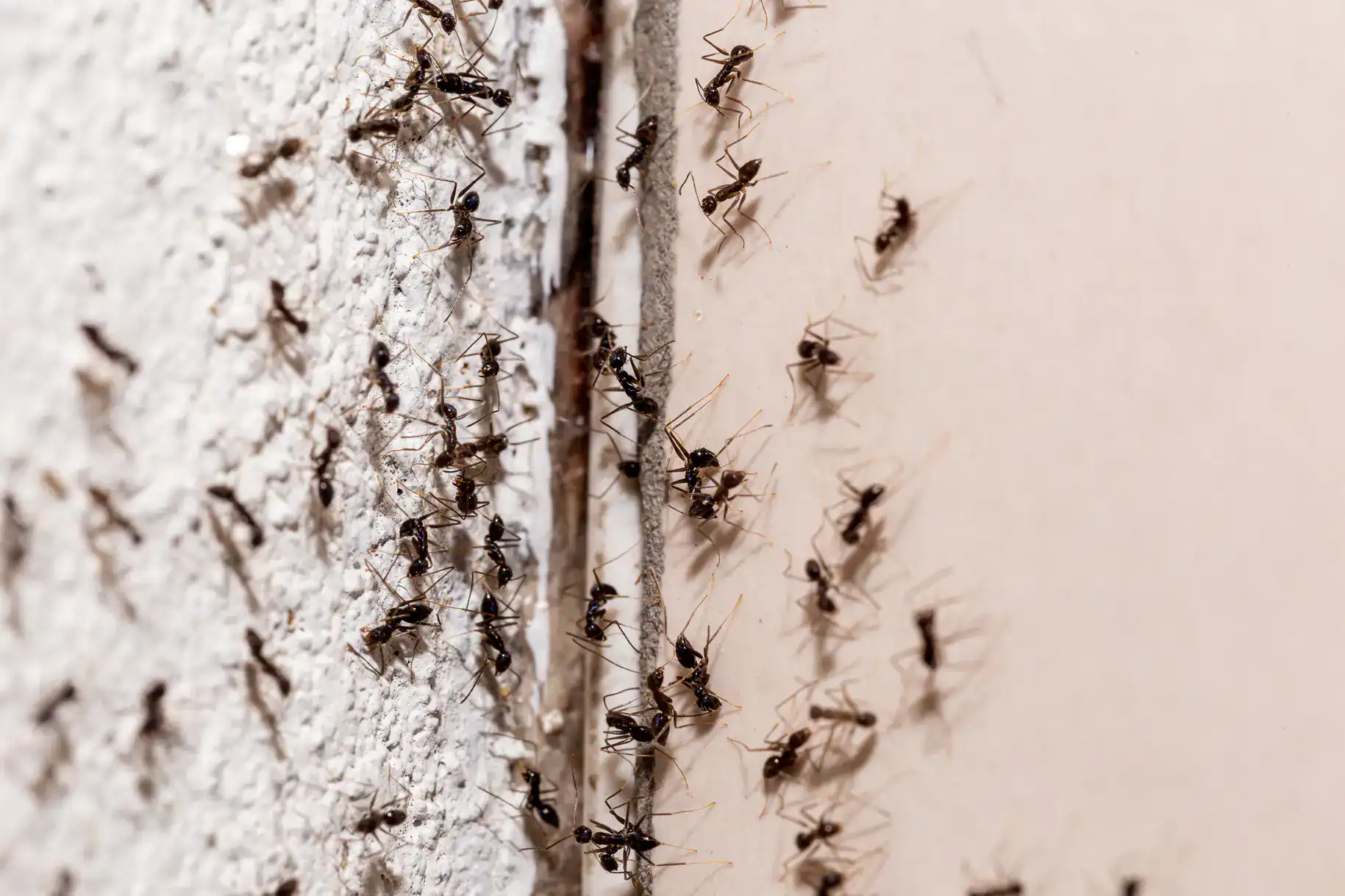
The ants on your counter aren’t the problem. They’re the symptom. The problem is a colony possibly thousands of individuals nesting inside a wall void, beneath your foundation, or in the aged wood framing that runs through Astoria’s pre-war building stock. Until that colony is eliminated, you will keep seeing ants. Spraying what you can see only disrupts foragers. It doesn’t touch the source.
When we handle ant control in Astoria, NY properly, the difference is immediate and lasting. No more trails across the kitchen. No more scouts appearing after every rainstorm. No more wondering whether the ants in your unit are coming from the apartment next door or the building next to yours. That last part matters more in Astoria than almost anywhere else because the attached brick townhouses on 31st Street and the multi-unit walk-ups off Ditmars Boulevard share foundations, wall voids, and utility chases that give ant colonies a direct highway between units.
Getting rid of ants in a connected Astoria building requires treating more than your apartment. It means addressing the perimeter, the entry points, and the trails that feed the infestation from outside. That’s what changes when the job is done properly not just fewer ants for a week, but a building environment that stops being hospitable to them.
We’ve been handling pest control across New York City’s five boroughs for over 40 years. That’s not a number to fill space it means we’ve worked in the exact type of buildings that make up Astoria: pre-war brick walk-ups, semi-detached two-families, attached row houses, and multi-unit properties where one ant problem can quietly become a building-wide one. We know how these structures behave because we’ve been treating them for decades.
We’re fully licensed, bonded, and insured, and we use only materials registered with the New York State Department of Environmental Conservation. Our A+ rating with the Better Business Bureau of New York State reflects a consistent standard not a one-time review push. And because pest problems don’t follow business hours, our phones are answered 24 hours a day, seven days a week.
Whether you’re renting a unit near Astoria Park, managing a multi-family property off Steinway Street, or dealing with carpenter ants in an older home in Ditmars-Steinway, you’re calling a company that has seen this before and knows exactly what to do about it.
It starts with identifying what you’re dealing with. Not all ants respond to the same treatment, and in Astoria’s apartment buildings, getting this wrong can make things significantly worse. Pharaoh ants common in Astoria’s heated, multi-unit buildings will split their colony into multiple new ones when disturbed by the wrong approach. That’s called budding, and it turns one infestation into several. So before we apply any materials, we figure out the species, the likely nesting location, and how the colony is moving through your space.
From there, we apply materials that forager ants carry back into the nest and share with the colony targeting the source, not just the visible trail. For Astoria properties, that also means treating the building exterior and any entry points along the foundation, window frames, or utility penetrations. In older buildings, those gaps are often how outdoor colonies including ones displaced by the construction activity along the Hallets Point waterfront find their way inside.
One treatment is rarely the end of it. Ant colonies are resilient, and satellite nests can restart an infestation that looked resolved. That’s why every initial cleanout is followed by a scheduled maintenance program weekly, every other week, or monthly to re-apply materials, check for new activity, and make sure the problem stays solved. You choose the schedule that fits your situation.
Ready to get started?
Ant control in Astoria, NY isn’t one-size-fits-all and it shouldn’t be. The neighborhood’s mix of pre-war walk-ups, attached brick townhouses, and multi-unit rentals creates conditions that most standard treatment approaches aren’t built for. Shared walls mean colonies migrate. Older wood framing means carpenter ants have been quietly nesting for years before anyone notices. Dense food corridors like Steinway Street sustain outdoor ant populations year-round, keeping pressure on nearby residential buildings even after interior treatment.
We offer ant exterminator services in Astoria that cover the full picture: interior treatment targeting active trails and likely nesting areas, exterior perimeter treatment to seal off entry points and disrupt foraging routes, and follow-up visits to monitor activity and re-apply materials as needed. For multi-unit buildings and property managers, we can coordinate building-wide service because treating one unit while the colony continues moving through shared spaces only delays the problem.
We also handle the species-specific situations that require a different approach entirely. Carpenter ant infestations in Astoria’s older homes need targeted treatment of the wood elements where they nest, not just a perimeter spray. Pharaoh ant infestations in apartment buildings require baiting protocols that eliminate the colony without triggering budding. Free estimates are available for all residential and commercial ant control services in Astoria, and a 10% senior discount applies for qualifying residents.
Store-bought sprays and bait traps work on the ants you can see the foragers. But foragers represent a small fraction of the colony. The rest of the colony, including the queen, is nesting somewhere you can’t reach: inside a wall void, beneath the floor, or in the building’s foundation. Until the colony itself is eliminated, foragers will keep coming. The colony simply produces more.
In Astoria’s attached buildings and multi-unit walk-ups, there’s another layer to this. Even if your treatment disrupts the colony activity in your unit, the colony may be centered in a neighboring unit’s wall or in the building’s shared foundation and it will continue sending foragers through shared pathways into your space. Professional ant control in Astoria, NY addresses the full picture: the interior of your unit, the building perimeter, and the entry points that connect your space to the colony’s actual location.
The three species that show up most consistently in Astoria properties are pavement ants, carpenter ants, and pharaoh ants and each one requires a different approach.
Pavement ants are the small, dark ants that enter through foundation cracks and basement penetrations, which are extremely common in Astoria’s older building stock. Carpenter ants are larger and are drawn to moisture-damaged wood the aged window frames, floor joists, and wall studs in Astoria’s pre-war buildings give them plenty of options. Pharaoh ants are the most problematic in multi-unit apartment buildings: they’re small, light-colored, and notorious for colony budding meaning improper treatment causes them to split into multiple new colonies and spread further through the building. Correctly identifying the species before treatment begins isn’t a formality. In Astoria’s connected buildings, it’s the difference between solving the problem and making it significantly worse.
Under New York City’s Housing Maintenance Code, landlords are required to maintain rental units free from pest infestations. If you’ve reported an ant problem to your landlord in writing and they haven’t taken action within a reasonable timeframe, you have the right to file a complaint with the NYC Department of Housing Preservation and Development (HPD), which can result in a formal violation against the property.
That said, many Astoria renters find themselves in a practical bind: the landlord is slow to act, or they send someone who does a surface-level treatment that doesn’t last. In those situations, some tenants choose to hire us directly and document the cost for potential reimbursement. Either way, knowing your rights matters and if you’re in a multi-unit building where the infestation is clearly coming from shared spaces or neighboring units, a building-wide service coordinated through the landlord or property manager is almost always the more effective long-term solution.
Heavy rain saturates the soil around outdoor ant colonies, flooding their nests and forcing foragers to move quickly to higher, drier ground. In Astoria, the East River proximity and the large green spaces Astoria Park’s 60 acres along the waterfront, Rainey Park on Vernon Boulevard mean there are substantial outdoor ant populations close to residential blocks. When those outdoor nests flood, the nearest available dry shelter is often the foundation of a residential building.
This is why ant invasions in Astoria apartments frequently spike after significant rain events, especially in spring and early summer when colonies are at peak population. The ants aren’t appearing from nowhere they’re relocating from saturated outdoor nests through the foundation cracks, utility penetrations, and window-frame gaps that are common in Astoria’s older building stock. A proper perimeter treatment applied before or immediately after heavy rain events can significantly reduce this kind of sudden influx.
Yes and in Astoria’s older homes, this is a real concern that’s easy to underestimate. Carpenter ants don’t eat wood the way termites do, but they excavate it to build their nests. Over time, that excavation weakens the wood elements they’ve colonized floor joists, wall studs, window frames, door frames and the damage accumulates silently, often for years before it’s visible.
Astoria’s pre-war housing stock the attached brick townhouses in Ditmars-Steinway, the two- and three-family homes on the blocks around Steinway Street, the older walk-ups throughout the neighborhood contains aged wood framing that has often experienced decades of moisture infiltration. Moisture-softened wood is exactly what carpenter ants prefer. If you’re seeing large, dark ants (roughly half an inch or longer) in your Astoria home, especially near windows, door frames, or in the basement, we should inspect the property before the damage progresses further. Early treatment is significantly less costly than structural repair.
Yes and for Astoria’s multi-unit buildings specifically, building-wide service is often the only approach that produces lasting results. When an ant colony is established in a shared foundation or wall void, treating individual units one at a time leaves the colony intact and the infestation ongoing. Foragers simply reroute through untreated units and continue cycling back into the treated ones.
We work with property managers and building owners throughout Astoria to coordinate ant control services across multiple units treating the building interior, the exterior perimeter, and the common areas where ant activity is concentrated. This is particularly relevant in the attached row houses and pre-war walk-ups that define much of Astoria’s residential streetscape, where a single colony can span multiple units through shared structural pathways. If you’re a property manager dealing with tenant complaints across multiple units, or a building owner who wants the problem handled properly rather than repeatedly, a free estimate is available and we can discuss a maintenance schedule that fits the building’s needs.
Useful Links
Other Services we provide in Astoria