Hear from Our Customers
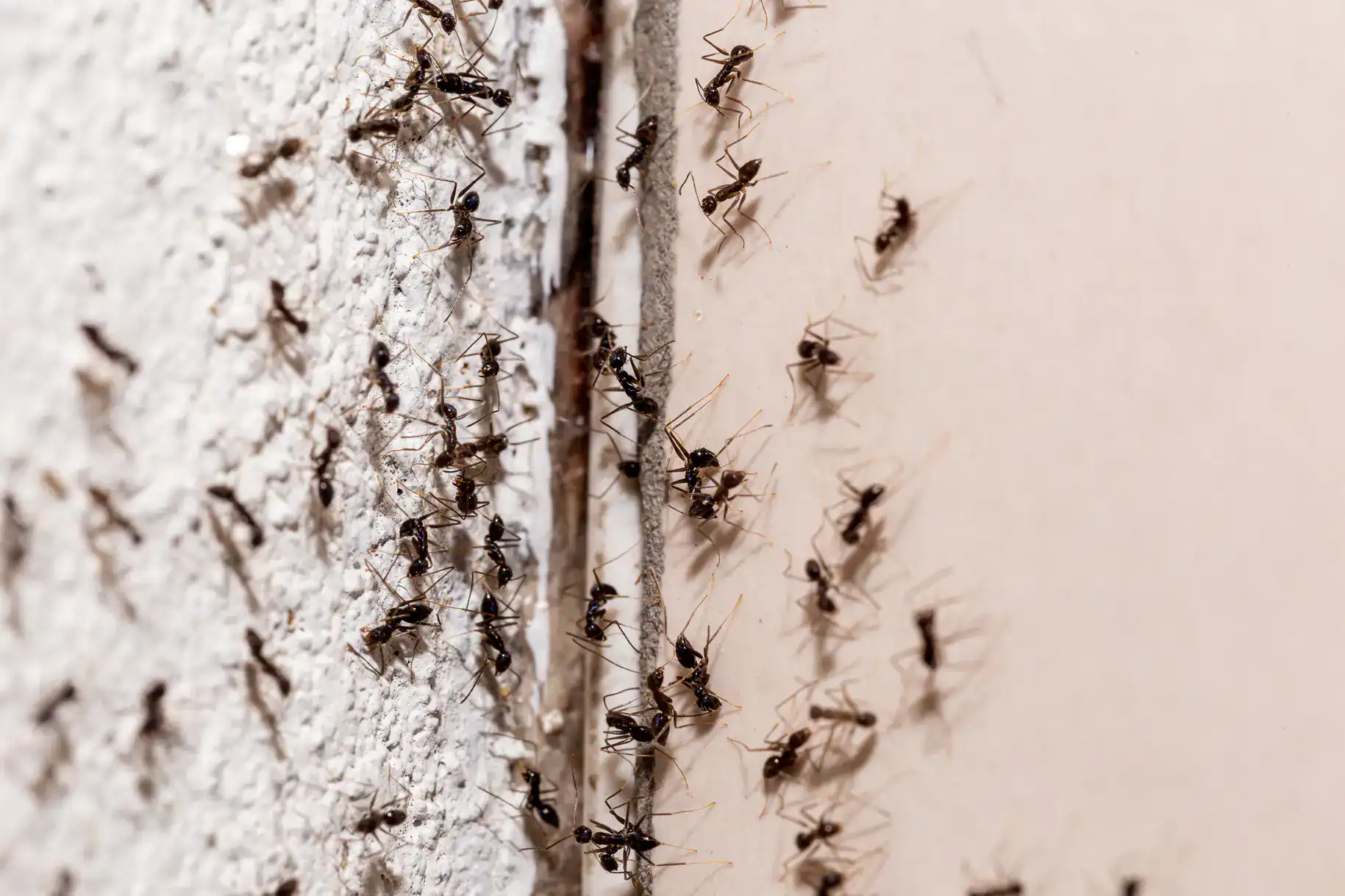
The ants trailing across your kitchen counter aren’t the problem. They’re a symptom. The colony potentially thousands of individuals nesting inside your walls, under your building’s foundation, or several floors away is the problem. Until that’s addressed, you’ll keep seeing ants no matter how many times you spray.
In Manhattan’s pre-war apartment buildings, particularly in neighborhoods like the Upper West Side, Harlem, and Washington Heights, aging wood and steam-heated walls create ideal conditions for carpenter ants and pharaoh ants year-round. These aren’t seasonal visitors. Manhattan’s older buildings stay warm enough through winter that active colonies never fully go dormant which means the problem doesn’t take a break just because it’s January.
Once the source is treated correctly, the difference is straightforward: no more trails, no more recurring sprays, no more wondering if your neighbor’s unit is feeding the same colony yours is. The right treatment targets the nest, not just the foragers. That’s what actually ends an infestation and it’s the only approach worth your time.
Kingsway Exterminating was founded on a straightforward idea: do the job right, show up when we say we will, and charge a fair price. That hasn’t changed in over four decades of serving New York City’s five boroughs, including Manhattan. From co-ops on the Upper East Side to tenement walk-ups in Washington Heights, the buildings here aren’t like anywhere else and neither are the pest challenges inside them.
Based in Brooklyn at 2216 Flatbush Avenue, we’re minutes from Manhattan via the Brooklyn Bridge and Hugh L. Carey Tunnel. We hold an A+ rating with the Better Business Bureau of New York State, are fully licensed, bonded, and insured, and use only NYS DEC-registered materials which matters in a city where landlords face real legal liability for hiring unqualified contractors under the NYC Housing Maintenance Code.
This isn’t a franchise. There’s no corporate call center. When you call, a real person answers 24 hours a day, seven days a week.
It starts with a free estimate. You describe what you’re seeing where the ants are, how long it’s been happening, whether you’ve tried anything already and we give you a clear picture of what the service will involve before any work begins. No mystery pricing, no pressure.
When our technician arrives, the first priority is identification. This step matters more than most people realize. Pharaoh ants the species most common in Manhattan’s high-rise and pre-war apartment buildings respond to repellent sprays by budding: the colony splits, spreads to other units or floors, and the infestation gets significantly worse. Treating pharaoh ants requires bait-based materials that forager ants carry back into the nest and share with the colony. Pavement ants pressing in from the sidewalk through foundation gaps need a different approach entirely. Getting the species right determines whether the treatment works or backfires.
The initial cleanout applies treatment materials both inside and outside the structure, targeting the source. Because ant colonies can have multiple queens and satellite nests especially in Manhattan’s interconnected building infrastructure a single visit is rarely the end of it. We schedule follow-up visits at weekly, bi-weekly, or monthly intervals based on the severity of the infestation, monitoring activity and re-applying as needed until the problem is fully resolved.
Ready to get started?
Ant control in Manhattan means dealing with a specific set of species in a specific built environment and our service reflects that. We handle the three species most commonly found in Manhattan residential and commercial buildings: pharaoh ants in heated multi-unit buildings, pavement ants at street level and in ground-floor units, and carpenter ants in the aging wood structures found throughout the Upper West Side, Harlem, and Washington Heights.
For pharaoh ant infestations which can travel through plumbing lines and electrical conduits across multiple floors we coordinate treatment to address the building as a system, not just a single unit. This is especially relevant in large complexes and older co-op buildings where shared infrastructure connects dozens of units. For carpenter ant infestations in pre-war construction, we focus on identifying moisture-damaged wood and structural entry points, not just applying materials and leaving.
We also work with property managers, building superintendents, and landlords who need documented, licensed service to stay compliant with New York City’s Housing Maintenance Code. All materials we use are registered with the NYS Department of Environmental Conservation. For commercial clients, we issue Demolition Clearance Certificates a specialized service most ant exterminators in Manhattan don’t offer. Residential service includes a 10% senior discount, and we provide free estimates for all new clients.
If you’ve sprayed and the ants came back or got worse there’s a good chance you’re dealing with pharaoh ants, which are the most common ant species in Manhattan’s heated apartment buildings. Pharaoh ants respond to repellent sprays by budding: the colony detects the chemical barrier, splits into multiple groups, and relocates to other areas of the building. What looked like a solution for a day or two becomes a larger, more spread-out infestation within a week.
The fix isn’t a stronger spray it’s a different method entirely. Pharaoh ants require bait-based treatment, where forager ants carry the material back into the nest and share it with the colony, including the queens. This is the only approach that targets the source rather than the visible trail. If you’re in a pre-war building in Harlem, the Upper West Side, or anywhere with steam heat running through the walls, there’s a reasonable chance this is exactly what’s happening in your unit.
Yes and in Manhattan specifically, this is one of the most common reasons infestations are so hard to resolve with a single-unit treatment. Pharaoh ants are small enough (roughly 1/16 of an inch) to travel through plumbing penetrations, electrical conduits, and wall voids between units and floors. Research has confirmed that pharaoh ant colonies in Manhattan apartment buildings can infiltrate units as high as the sixth floor using exactly these pathways.
This is why treating only your unit often doesn’t work long-term. If the colony has satellite nests in adjacent units or on another floor, forager ants will simply re-establish routes into your apartment once the immediate treatment fades. Effective treatment in a multi-unit Manhattan building typically requires coordination with building management to address the infestation across the affected area not just the unit where the ants are visible.
Under New York City’s Housing Maintenance Code, landlords are legally required to keep apartment units free from pests and to maintain pest-resistant conditions in all common areas of the building. This obligation includes not just eliminating the infestation but addressing the underlying causes moisture intrusion, structural gaps, and plumbing issues that allow ants to enter and persist. A landlord cannot legally ignore a documented ant infestation or shift the full responsibility to a tenant without evidence that the tenant caused the problem.
If your landlord isn’t responding, you have a few options. Filing a 311 complaint triggers an HPD inspection. You can also pursue Housing Court action, which can result in court-ordered extermination or a rent abatement. Rent-stabilized tenants have additional options through the New York State Division of Housing and Community Renewal. If your building management does hire an exterminator, they are required by law to verify that the contractor holds a valid NYS DEC pest control applicator license so it’s worth asking.
It matters quite a bit. Carpenter ants are significantly larger than pavement ants or pharaoh ants usually between half an inch and an inch long and they’re black or dark brown. They don’t eat wood, but they excavate it to build nesting galleries, which causes real structural damage over time. In Manhattan’s pre-war brownstones and older apartment buildings particularly in the Upper West Side, Harlem, and Washington Heights original wood framing, window surrounds, and floor joists are still intact in many buildings. Moisture-damaged wood in these structures is exactly what carpenter ants look for.
Pavement ants are much smaller, typically dark brown, and usually found trailing along baseboards or entering through gaps near plumbing. They nest under sidewalk cracks and building foundations which is why ground-floor and garden-level apartments on almost any block in Manhattan deal with them regularly. The treatment approach for each species is different, which is why identification comes before any product is applied.
Outdoors, ant activity slows significantly once temperatures drop. But inside Manhattan’s pre-war apartment buildings especially those heated by steam systems that keep interior wall temperatures well above 70°F even when it’s freezing outside colonies don’t necessarily go dormant. Pharaoh ants in particular are tropical in origin and thrive in warm, humid environments. A steam-heated pre-war building in January is a perfectly comfortable habitat for an active pharaoh ant colony.
This means that if you’re seeing ants in your apartment in December or February, it’s not unusual and it doesn’t mean the infestation is minor. Year-round ant activity in Manhattan’s older building stock is well-documented, and it’s one of the reasons that ongoing maintenance visits, rather than a single one-time treatment, are often the most practical approach for buildings where the underlying conditions don’t change with the season.
A good starting point is asking your neighbors. If multiple units on your floor or on floors above or below you are seeing the same type of ant, you’re almost certainly dealing with a building-level infestation rather than an isolated one. This is especially common in Manhattan’s larger residential buildings, like the pre-war apartment towers along the Upper West Side or the dense multi-unit buildings in Washington Heights, where shared plumbing and electrical infrastructure connects dozens of units.
Single-unit treatment can work when the infestation is genuinely contained typically in ground-floor apartments dealing with pavement ants entering through a specific foundation gap that can be sealed. But for pharaoh ant infestations in heated multi-unit buildings, treating one apartment while connected units remain untreated usually just relocates the problem temporarily. We can assess the scope during the initial visit and advise on whether building management coordination is necessary and if it is, we have experience working directly with property managers and superintendents to get it handled at the right level.
Useful Links