
Hear from Our Customers
You stop dreading the kitchen at night. You stop second-guessing whether the spray you bought at the hardware store did anything. You stop wondering if the problem is coming from your neighbor’s unit, the pipe chase behind your wall, or somewhere else entirely you can’t see or reach. That’s what real cockroach control in Kew Gardens looks like not a temporary fix, but an actual resolution.
Here’s what most people in Kew Gardens are dealing with that store-bought products can’t touch: cockroach colonies living inside the wall cavities and pipe runs of pre-war buildings. These buildings many of them six-story brick co-ops developed in the 1920s and 1930s were never designed with pest exclusion in mind. The shared plumbing, the original cabinetry, the steam-pipe chases that stay warm year-round all of it creates the exact environment German cockroaches need to establish and grow a colony. Treating your unit alone won’t solve a problem that lives in the building’s infrastructure.
And if you’re on the streets closer to Forest Park, you may be dealing with something different altogether: American cockroaches the large ones New Yorkers call waterbugs migrating up from storm drains and sewer lines, especially after heavy rain. That’s a different pest, a different entry point, and a different treatment approach. Knowing which problem you have from the start is what separates a real solution from another wasted treatment.
We’ve been operating out of Brooklyn since the 1980s founded by Richard Kourbage Sr., built over five decades, and still a family business today. That’s not a talking point. It means every technician who walks into your Kew Gardens apartment or home represents a company whose name and livelihood depend on doing the job right.
We hold a consistent A+ rating with the Better Business Bureau of New York State, are fully licensed, bonded, and insured, and use only NYS Department of Environmental Conservation Registered Materials which matters when you’re treating a pre-war co-op in Kew Gardens where children and pets share close quarters with the infestation. Our staff collectively brings over 100 years of hands-on pest control experience to the table, across every borough, every building type, and every pest scenario New York City produces.
From Marine Park, Kew Gardens is a natural service area accessible through Richmond Hill and Woodhaven along routes our technicians travel regularly. This isn’t a company treating your neighborhood as a distant stop on a long route. We know Queens, we know the buildings in Kew Gardens, and we’ve been doing this work in this city long enough to have seen every version of the problem you’re dealing with.
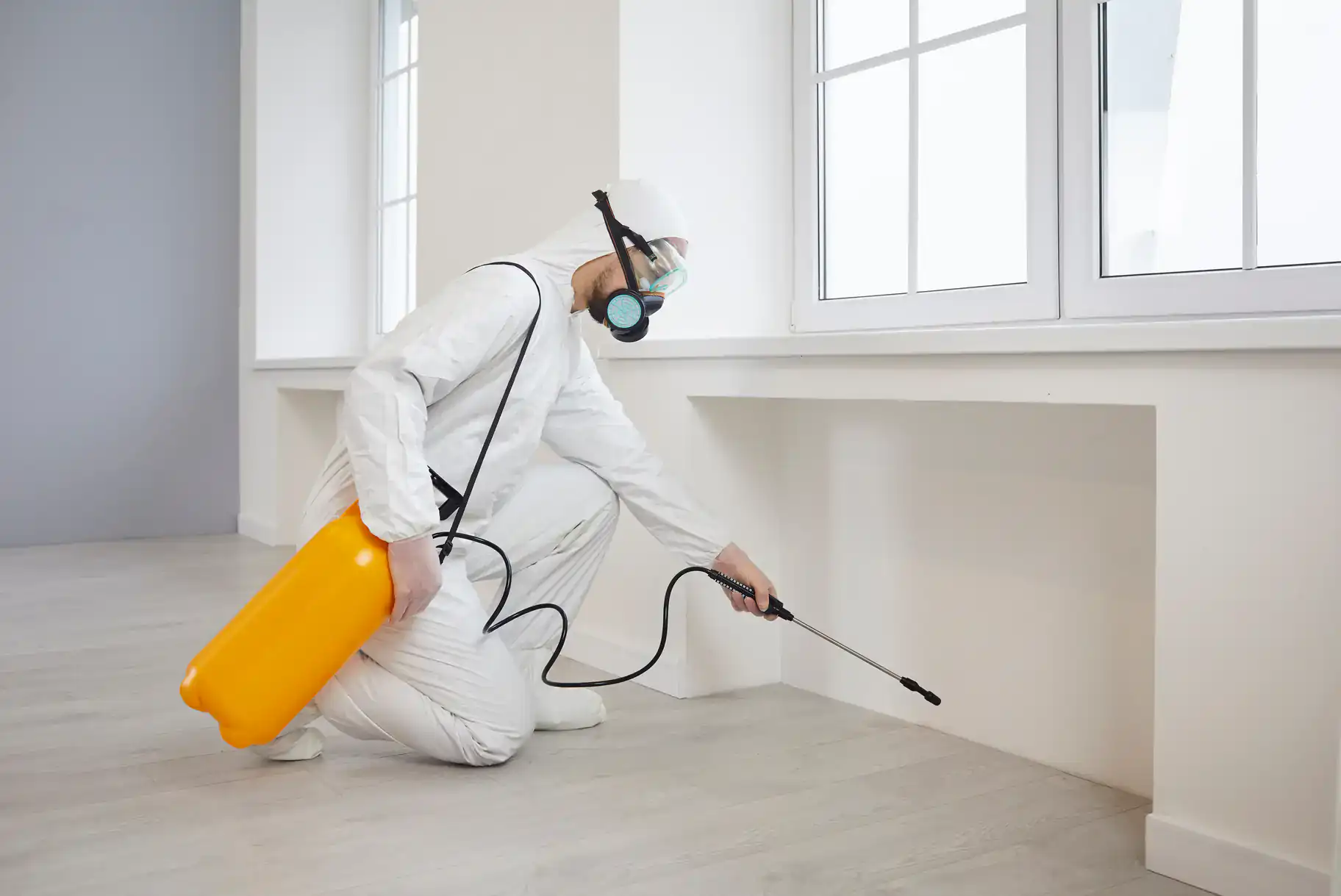
It starts with an inspection not a quick walkthrough, but a real one. Our technician identifies the species, locates the harborage sites, and assesses how the infestation is moving through the unit or building. In Kew Gardens’ pre-war apartment buildings, that often means looking behind original cabinetry, around radiator connections, inside pipe chases, and in the wall voids that older construction leaves wide open. The inspection determines everything that comes next.
From there, the treatment is built around what was actually found not a standard spray applied the same way in every home. German cockroach infestations in multi-unit buildings require a targeted combination of gel bait placed at harborage sites, crack-and-crevice treatment, insect growth regulators to disrupt the reproductive cycle, and dust applied in voids where liquid products can’t reach. If you’re dealing with waterbugs migrating from the Forest Park drainage corridor or the sewer infrastructure along Kew Gardens’ western streets, the focus shifts to entry-point identification and perimeter treatment. The method changes because the pest and the source are different.
One visit is rarely the end of it and any exterminator who tells you otherwise isn’t being straight with you. Cockroach eggs are resistant to most pesticides, which means newly hatched nymphs will emerge two to four weeks after the initial treatment. Follow-up visits are built into the process for exactly this reason. For buildings or residents who need ongoing protection, we offer maintenance schedules weekly, monthly, or every other month so the problem doesn’t quietly rebuild between treatments.
Ready to get started?
Cockroach pest control in Kew Gardens isn’t one-size-fits-all, and our service reflects that. Whether you’re a renter in one of the apartment buildings along Lefferts Boulevard, a co-op owner in a pre-war six-story on a side street off Queens Boulevard, or a homeowner on one of the quieter blocks near Maple Grove Cemetery dealing with seasonal waterbug intrusions we build our approach around your specific situation, not a generic treatment checklist.
Every service includes a thorough inspection, species identification, and a targeted treatment using NYS DEC Registered Materials. That last point matters in a neighborhood with the building density and shared-wall construction that Kew Gardens has you want to know what’s being applied, and you want to know it’s been approved for use in residential settings by the state of New York. We also work directly with property managers, landlords, and co-op boards when building-wide coordination is needed. If you’ve received a NYC housing code violation cockroach infestations are classified as Class C, meaning immediately hazardous, with a required 24-hour landlord response we know exactly what documentation and treatment scope is needed to bring the property into compliance.
For senior residents, we offer a 10% discount. In a neighborhood where a significant share of long-established residents live in older buildings on fixed incomes, pest control shouldn’t be something people put off because of cost. It’s a health issue, not a luxury and our pricing reflects that.
This is the most common frustration in Kew Gardens’ pre-war apartment buildings, and the answer almost always comes down to shared infrastructure. When cockroaches are living inside the wall cavities, pipe chases, or shared plumbing runs of a multi-unit building which is the norm in the six-story brick co-ops and rental buildings that dominate this neighborhood treating one unit doesn’t eliminate the source. The colony is in the building, not just your apartment. Cockroaches from adjacent units, the floor above, or the floor below can repopulate your space within weeks of a single treatment.
The other factor is eggs. Cockroach egg cases (called ootheca) are physically resistant to most pesticides, which means even a thorough treatment that kills every adult and nymph in the unit will leave behind eggs that hatch two to four weeks later. This is why follow-up visits aren’t optional they’re the part of the process that actually finishes the job. A real solution in a Kew Gardens apartment building accounts for both the building-level source and the egg cycle, not just the cockroaches you can see.
Yes and in Kew Gardens specifically, this is one of the defining challenges of cockroach control. The pre-war brick buildings that characterize this neighborhood were built with larger wall voids, original plumbing runs through shared walls, and pipe chases that connect units vertically throughout the building. Cockroaches use these pathways freely. A colony established in a unit two floors below yours can send foragers and eventually establish satellite populations in your kitchen or bathroom without any direct contact between units or tenants.
This is also why a neighbor’s infestation is your problem, whether you’ve seen cockroaches yet or not. In a building where one unit is heavily infested and untreated, the pressure on surrounding units increases over time. If your landlord or co-op board is slow to address the building-level issue, having your individual unit treated is still worth doing it reduces the population in your space and creates a barrier but it works best as part of a coordinated, building-wide approach. We work with both individual tenants and property managers in Kew Gardens for exactly this reason.
Those are American cockroaches what most New Yorkers call waterbugs. They’re a different pest than the small German cockroaches that infest kitchens and bathrooms, and they require a different treatment approach. American cockroaches live primarily in outdoor environments: sewer lines, storm drains, catch basins, and the drainage infrastructure that runs along the edge of Forest Park. They come indoors when conditions drive them there heavy rain events that flood their underground habitat, or dropping temperatures in late fall when they’re looking for warmth.
If you’re on one of the residential streets on Kew Gardens’ western side closer to the park along Park Lane, Abingdon Road, or the 118th Street corridor you’re more likely to experience this kind of intrusion than residents deeper in the neighborhood. The treatment focus for waterbugs is different: entry-point identification, perimeter treatment, and sealing the gaps in your foundation, utility penetrations, and drain connections that give them access to your home. Gel bait and interior crack-and-crevice treatment alone won’t solve a waterbug problem the source is outside, and that’s where the solution starts.
Yes. Under New York City’s Housing Maintenance Code, a cockroach infestation is classified as a Class C violation the most severe category, defined as immediately hazardous. That classification requires your landlord to respond within 24 hours of a formal complaint. All building owners in New York City are legally required to provide housing free of pests and to take active steps to prevent and address infestations.
If your landlord has been slow to act, you have a few options. You can file a complaint through 311 or through the NYC Department of Housing Preservation and Development (HPD), which will initiate an inspection and can result in a formal violation being issued against the property owner. You can also hire an exterminator independently which is your right as a tenant while the landlord-tenant issue is being resolved. Many Kew Gardens renters in this situation call us directly to treat their unit while a 311 complaint or HPD process is underway. We also work with landlords and property managers who need to remediate a violation and bring their building into compliance quickly.
This is one of the most common questions from residents in Kew Gardens’ denser apartment buildings, and it’s a completely reasonable one. The short answer is yes when treatments are applied by a licensed professional using registered materials. We use only NYS Department of Environmental Conservation Registered Materials, which means every product applied in your home has been reviewed and approved by the state for use in residential settings. These aren’t industrial chemicals applied carelessly they’re targeted treatments applied in specific locations, at specific concentrations, by certified technicians.
In a pre-war apartment with children or pets, the application method matters as much as the product. Gel bait, for example, is placed in small amounts inside cracks, crevices, and cabinet interiors not sprayed across open surfaces. Dust treatments go into wall voids and pipe chases where children and pets don’t have access. Your technician will walk you through any preparation steps before the visit and any post-treatment precautions typically as simple as keeping children and pets out of treated areas for a short period while products dry or settle. The cockroaches themselves, carrying Salmonella and documented asthma-triggering allergens, pose a more significant health risk to your household than a properly applied, professionally supervised treatment.
Preparation makes a real difference in how effective the treatment is, and it’s not complicated. Before the technician arrives, clear out the areas under your kitchen and bathroom sinks these are primary harborage and treatment zones. Pull small appliances away from the wall, particularly the refrigerator and stove, since cockroaches concentrate in the warm spaces behind and beneath them. If you have items stored in lower kitchen cabinets, remove them so the technician has full access to the cabinet interiors. In a pre-war Kew Gardens apartment, the spaces behind original cabinetry and around radiator connections are often where the infestation is densest, so access to those areas matters.
If you have children or pets, plan to keep them out of the kitchen and bathroom for a few hours after treatment your technician will give you a specific timeframe based on what products are being used. After the treatment, avoid wiping down surfaces where gel bait has been placed that bait is doing its job and needs to stay in place. Don’t spray your own products over the treated areas either; some store-bought repellents can interfere with professional-grade bait by driving cockroaches away from it before they ingest a lethal dose. The preparation is simple, but following through on it is what lets the treatment work the way it’s supposed to.
Useful Links
Other Services we provide in Kew Gardens